Stochastic Optimal Control and Real Options Theory Approach for Batch and Bio-processing
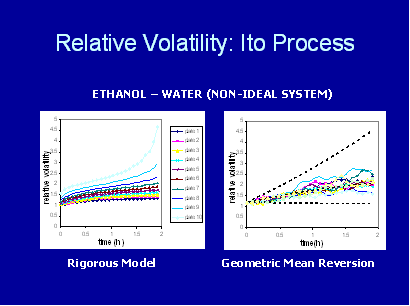
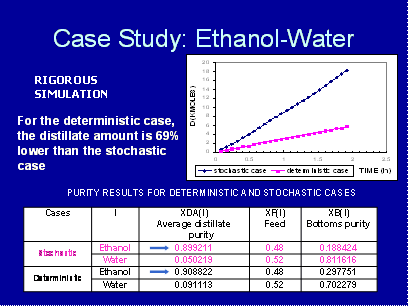
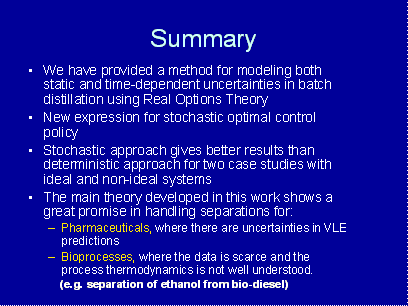
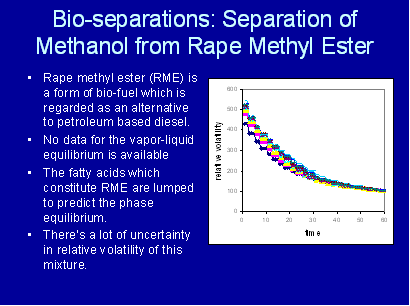
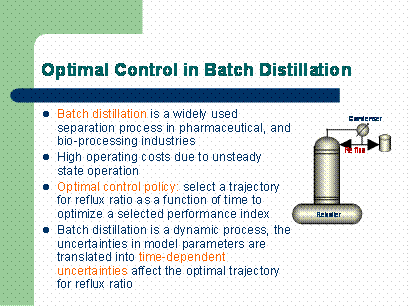
Batch distillation is an important separation process for small-scale production especially in pharmaceutical, specialty chemical and biochemical industries. Although batch distillation units require lower capital cost than continuous units, the unsteady state nature of the process, results in higher operating costs. Optimal control in batch distillation is a mode of operation which allows us to optimize the column operating policy by selecting a trajectory for reflux ratio. Due to the uncertainties in thermodynamic models the reflux ratio profile obtained is often suboptimal. Recently a new method was proposed by Rico-Ramirez et al. (2003) to include time-dependent uncertainties in current formulations of batch distillation optimal control for ideal systems. In this work, a general approach is proposed to handle both dynamic and static uncertainties in thermodynamics for more complex non-ideal systems. The static uncertainties result from the inaccuracies associated with predicting vapor-liquid equilibrium using group contribution methods such as UNIFAC. The unsteady state nature of batch distillation translates these static uncertainties into time-dependent uncertainties. A new Ito process representation is proposed for the dynamic behavior of relative volatility for non-ideal mixtures. Numerical case studies are presented to demonstrate the usefulness of this approach for batch as well as bio-processing. The case studies show that the stochastic approach improves the results (i.e. the product yield) up to 69%.

Uncertainties in Parameter Estimation and Optimal Control in Batch Distillation
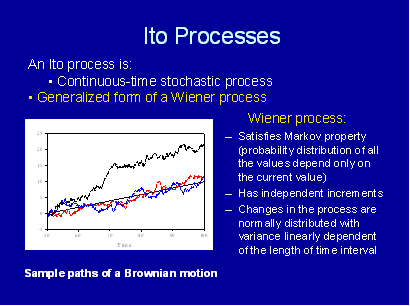
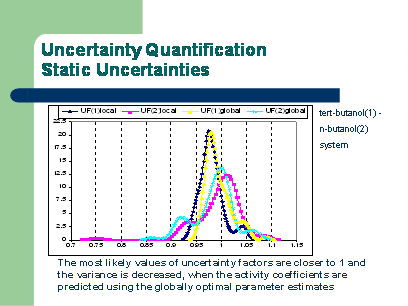
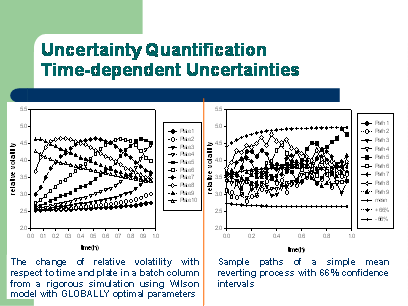
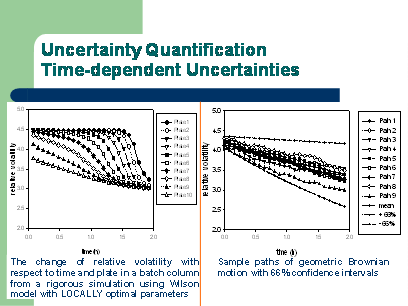
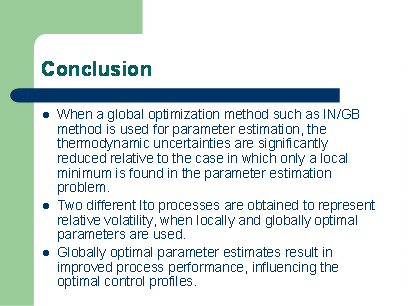
Optimal control problems in batch distillation involve finding a trajectory for the reflux ratio so as to maximize a performance index. Then the controller is asked to follow this trajectory in an open loop fashion. It is important to minimize the effect of uncertainties in thermodynamic models on the optimal control profiles to achieve a better operating performance. The nonlinear parameter estimation problem in vapor-liquid equilibrium modeling involves determining the values of model parameters, which provide the best fit to experimental data. It was shown previously by Gau et al. [Fluid Phase Equilibria, 168, 1-8, (2000)] that, using a global optimization procedure based on interval-Newton technique combined with interval-branch-and-bound can significantly reduce the error between the predicted and experimental data. Using this method, it was also shown that for some of the data sets published in DECHEMA, the parameters estimated correspond to local minima. The effect of locally and globally optimal parameter estimates on batch distillation optimal control profiles is demonstrated in this work. Since batch distillation is a dynamic process, the static (parametric) uncertainties are translated into time-dependent uncertainties. The time-dependent changes in relative volatility for the two cases are analyzed and represented by Ito processes. Next, the optimal control problem is solved using the maximum principle and NLP approach. Numerical case studies show that using globally optimal parameter estimates versus locally optimal parameter estimates results in a better product yield and the minimum error between the specified purity and the purity that is achieved.

Integrating Product and Process Design with Optimal Control: A Case Study of Solvent Recycling in Pharmaceutical Industry
An integrated framework was developed that involves solvent selection, solvent recycling and optimal operation under uncertainty for batch processing industries. This framework was applied to a solvent recycling problem in peptide drug production. For binary azeotropic systems, this framework selects candidate solvents based on computer-aided molecular design. Then the optimal batch column configuration is selected based on the parameters for separation and heuristics. Finally the optimal operation policy is found for the best column configuration. It was shown that similar to the optimal reflux policy for the rectifier, the optimal reboil policy improves the product yield significantly for the stripper and middle vessel column configurations and results in the most profitable operation.
Uncertainties were considered in two categories in this framework: static uncertainties and time-dependent uncertainties. The static uncertainties constitute the uncertainties in UNIFAC which have a significant effect on the CAMD model. An efficient sampling technique, the Hammersley Sequence Sampling, HSS sampling was used to deal with static uncertainties. Since batch distillation is a dynamic process, the static uncertainties are translated into dynamic uncertainties, which in turn affect the optimal operating profiles. These dynamic uncertainties were modeled using Ito processes in this project.
